Federal Building and Post Office

Federal Building and Post Office — Chicago

Life Span: 1904–1965
Location: Dearborn, Adams & Clark Streets and Jackson Boulevard, Chicago
Architect: Henry Ives Cobb


The new Federal Building and Post Office in Chicago was a major civic project around the turn of the 20th century. It was designed by Henry Ives Cobb and occupied the full block bounded by Dearborn, Adams, Clark and Jackson. The building featured an imposing dome, extensive stonework, and sculptural groups intended to symbolize the globe and mail service. 0

Chicago Tribune headline about Cobb's plans
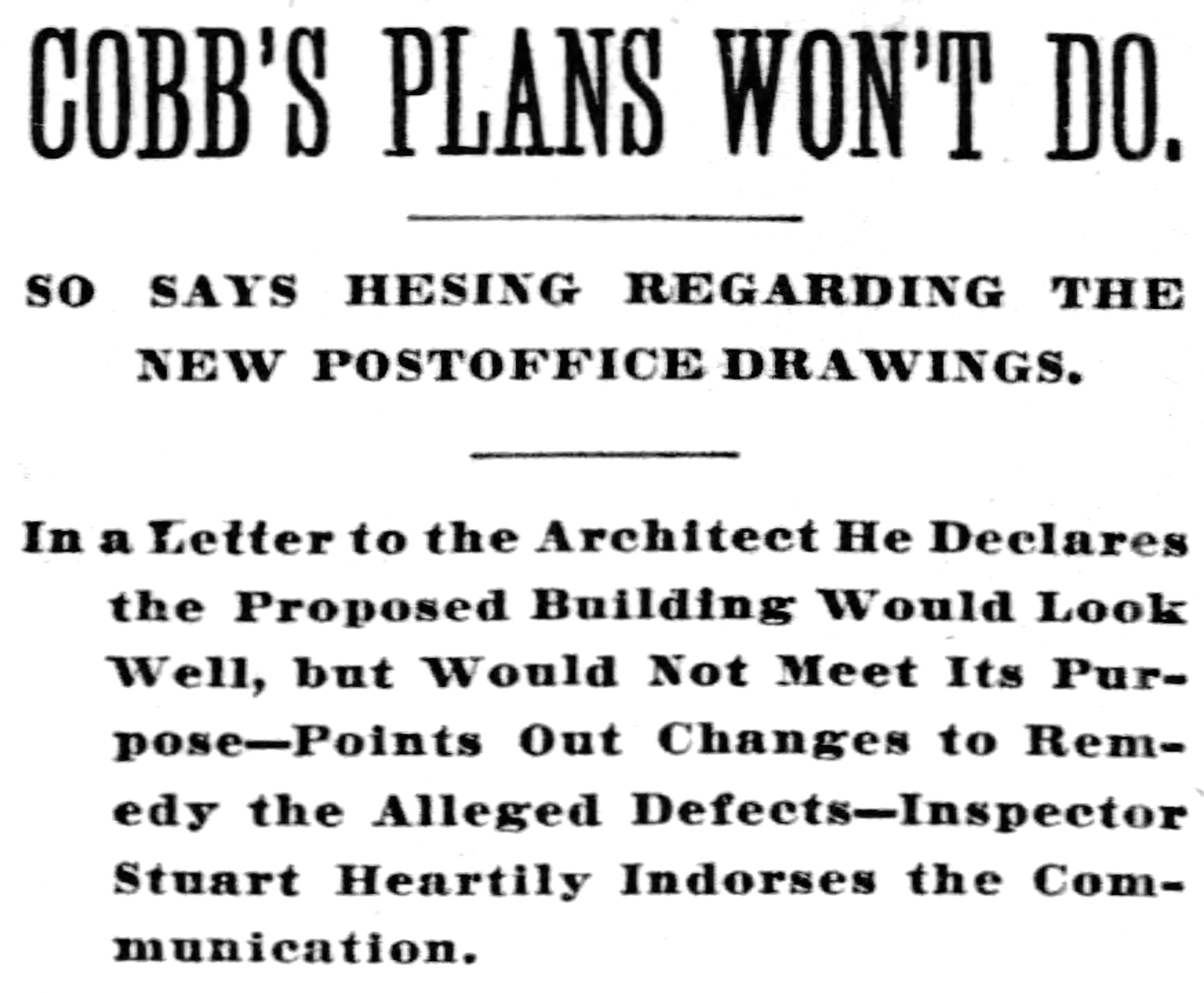
Chicago Tribune headline re: Cobb's plans (Dec 9, 1896). 1

Planning and early debate

Newspaper coverage from the 1890s records detailed debates between the architect and post office officials about interior arrangements and the location of postal workspaces. Postmaster Washington Hesing insisted that the post office needs — particularly large, open work floors and street-level mail handling — must be prioritized in the final plans. 2

Elevation drawing of the Federal Building
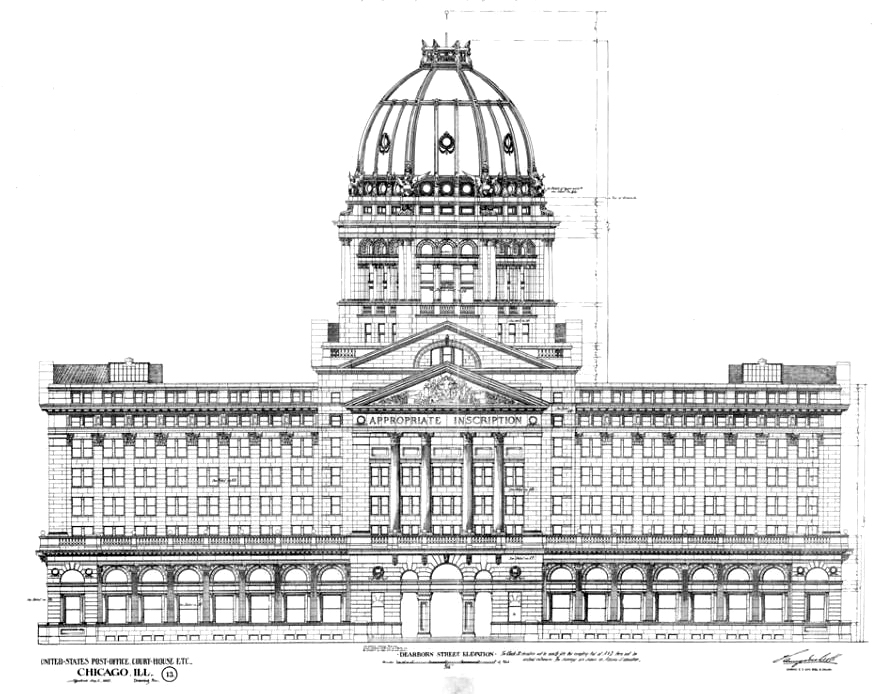
Elevation drawing of the U.S. Government Building (April 1898). 3

Design highlights

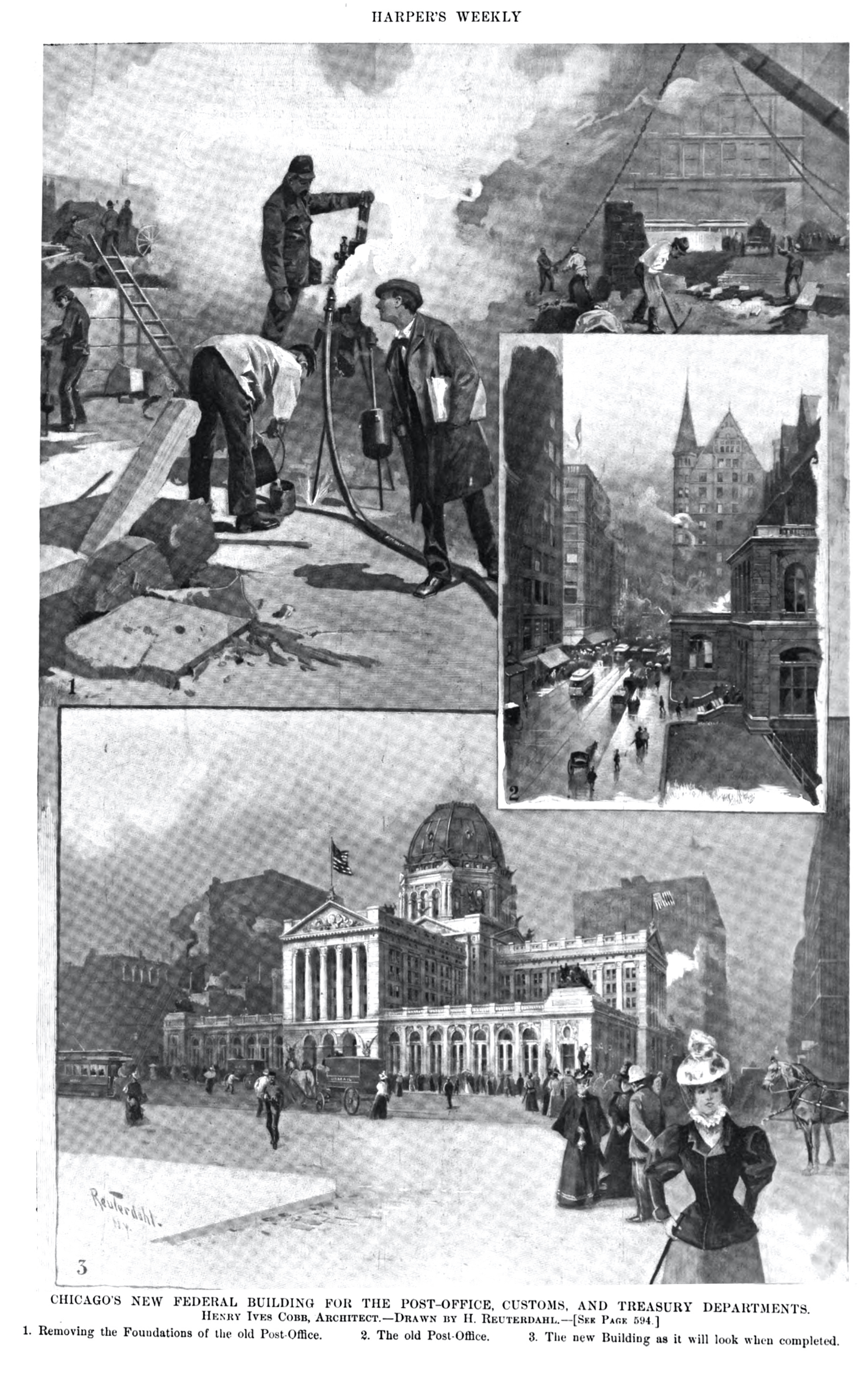
Contemporary reports praised the building’s monumental qualities — a cruciform massing topped by a large dome, and plans for four colossal bronze sculptural groups at the corners that would represent America, Europe, Asia and Africa. Harper’s Weekly described the dome and pyramidized massing as giving the structure an impressive architectural presence in the heart of the city. 4

Harper's Weekly illustration of the new government building
Harper’s Weekly illustration of the new government building (1897). 5

Construction notes and reaction

Construction progressed in the early 1900s; reporting describes massive stonework and the hoisting of the last stones in 1902. By 1905 an editorial in the Chicago Tribune criticized the post office layout despite admiring the building’s architectural grandeur — calling the finished post office a “botch” from a practical standpoint even as it was visually imposing. 6


This post reproduces text and images from Chicagology’s page on the Federal Building and Post Office. Original source: Chicagology — “Federal Building and Post Office.” 7

Read the original Chicagology page

TAGS: federal building, post office, Chicago, Henry Ives Cobb, 1900s architecture, dome, Harper's Weekly

Comments

Popular posts from this blog

The 1772–1773 Bladen County “Mob Raitously Assembled” and the Early Ancestors of the Lumbee

The 1772–1773 Bladen County “Mob Raitously Assembled” and the Early Ancestors of the Lumbee In 1772–1773, colonial North Carolina faced a crisis in Bladen County that would ripple across centuries, leaving its mark on families who would later be recognized as central to Lumbee history. Governor Arthur Dobbs, acting on intelligence from his agent and militia commander, Colonel Griffith Rutherford, reported to the General Assembly a startling list titled: “A list of the mob raitously assembled together in Bladen County October 13th 1773.” The report described the accused not as isolated lawbreakers but as a collective threat to civil order. What makes this document particularly significant is its explicit racial classification: “The above list of rogues is all free negroes and mullattoes living upon the King’s land.” This language reveals how the colonial government perceived these families. They were not simply settlers or Indian communities—they were a racially defined popula...

Who are the Melungeons?

Who the Melungeons Are The Melungeons are a group of historically mixed-ancestry people who settled in the Appalachian borderlands, particularly in east Tennessee, southwest Virginia, and parts of Kentucky and North Carolina. They emerged in a society that demanded strict racial divisions, yet their appearance and family histories often defied such boundaries. Outsiders used the word “Melungeon” as a slur to describe families who seemed neither fully white nor fully Black, and the label stuck to entire communities. Historian Wayne Winkler explained that Melungeons “lived on the margins of society, neither enslaved nor fully free” and were often classified differently depending on the county or census taker. Census records from the 19th century alternately labeled them as “free people of color,” “mulatto,” “Indian,” or occasionally white. These inconsistent labels reflected the reality that their mixed ancestry — European, African, and Native American — plac...

Debunking the “Black Japan” Story By Bella Newberry

  Bella Newberry’s Continuous Bait-and-Switch Scam: Debunking the “Black Japan” Story Social media influencer Bella Newberry, known online as @truecrimewithbella , has recently shared a viral video claiming that Japan had Black kings and dark-skinned queens, stating that the Meiji dynasty “bleached the bloodline” and that ancient Japanese dynasties had African ancestry. You can view the video here: In her narration, Newberry claims: "Japan had black kings and dark-skinned black women queens this is what they didn't tell you in school before they bleached the bloodline in the Meiji dynasty… you had the kuro the black kings yeah look it up kuro means black means king… ever heard of the jomon the people with thick hair dark skin and broad faces very broad nose those are from the original islanders… then you had the satsuma and ryoku noble dynasty this is black af history it goes into all of these things the things they did not teach you in school…" While these ...